
Queers Rush In (Part 3)
The normalization of gay people posed a crisis for queer theorists

“Far from redefining gay identity, ‘queer’ radicalism may actually have to define itself in opposition to it.”
–Andrew Sullivan (1993)
Welcome to 2026. The word “queer” has made it to the mainstream. Queer theory’s friend, trans ideology, dominates America’s hospitals and schools. But how is queer theory doing as an intellectual movement?
This is Part 3 of a trilogy on queer theory. In Part 1 I introduced its lesbian founders, Gayle Rubin and Judith Butler, who rebelled against feminist orthodoxy in the 1980s. In Part 2, focused on the hetero Eve Kosofsky Sedgwick, I broke down these women’s weird crush on gay guys and explained why their ideas took root on campus. Now, moving into the 21st century, I’ll unpack queer theorists’ antipathy toward gay marriage and their cooptation by trans ideologues. Throughout, I’ll continue to flag pedophile allyship.
But first, a flashback.
Michel Foucault (1926-84)
Michel Foucault was a gay French philosopher whose work questioned prevailing morality, including laws and norms against sex with children. He’s known for promiscuity and rumored to have had sex with boys aged 8-10 in Tunisia. He thought power, and therefore social reality, was constructed out of words and ideas (“discourse”). The upshot: reality doesn’t come from nature. Ideas don’t prevail simply because they are correct.
Foucault undermined conventional views by purporting to expose where they came from. Stanford Encyclopedia of Philosophy:
“He does not claim that sex, understood as the categories of maleness and femaleness, was invented in a particular historical period. He rather analyses the ways in which these categories were founded and explained in discourses claiming the status of scientific truth, and how this allegedly ‘pure’ explanation in fact constituted these categories so that they were understood as ‘natural.’”
All this talk about the supremacy of ideas over nature was very affirming to bookworms. Foucault became a rock star within academia. Younger scholars wanted to be him. Rubin, Sedgwick, and Butler were especially smitten. They cited him liberally; he’s considered a major influence on queer theory.
Foucault’s dark sexiness and indifference to women represented the polar opposite of prudish 1980s feminism. As the founding queers revolted against anti-porn crusaders, they lavished attention on the denizens of Foucault’s world: drag queens, dying poets, pedos and dungeon dwellers.
In the 1990s, the fourth wall shattered as a real live gay man sat down at their lunch table: Michael Warner, an English professor who’d built his career in early US literary studies.
“Fear of a Queer Planet: Queer Politics and Social Theory” (1993)
In 1993, Warner edited Fear of a Queer Planet. His introduction, a jumble of academic jargon, uses queer and gay as synonyms when applied to individuals (gay people are queer, queer people are gay) but antonyms when applied to “politics” (gay politics is basic, queer politics is daring and intellectual).
While gays and queers are the same population, they make different choices about labels. “The preference for ‘queer’ [over gay] represents … a more thorough resistance to regimes of the normal.” Warner later allows that “not all gays and lesbians share this [essay’s] view of the new queer politics.” But he never says explicitly that some gays aren’t queer. (He also doesn’t allude to heterosexual queers.) Just like Sedgwick, he seems to intuit that queerness needs gay people – every last one of us with no defectors – to anchor itself in reality.
Warner doesn’t even consider the idea that gay/queer people are born that way. Their sexual orientation is either imposed by others or it’s a choice:
“Identity as lesbian or gay is ambiguously given and chosen, in some ways ascribed and in other ways the product of the performative act of coming out[.]”
Warner explains how someone becomes queer:
“Every person who comes to a queer self-understanding knows in one way or another that her stigmatization is connected with gender, the family, notions of individual freedom, the state, public speech, consumption and desire, nature and culture, maturation, reproductive politics, racial and national fantasy, class identity, truth and trust, censorship, intimate life and social display, terror and violence, health care, and deep cultural norms about the bearing of the body. Being queer means fighting about these issues all the time … Queers do a kind of practical social reflection just in finding ways of being queer. (Alternatively many people invest the better parts of their lives to avoid such a self-understanding and the social reflection it would imply.)”
If a lesbian doesn’t reflect on racial fantasy, can she truly be called queer? The parenthetical at the end suggests such a person exists, is not in fact queer, and merits derision. But again, Warner can’t just say, “these homos aren’t queer.”
If a woman is hostile to “social reflection” and the like, why doesn’t she shed “stigmatization” by seeking a husband? The obvious answer is she’s wired for attraction to women, not men. But Warner lets the question hang in the air.
So much for defining queer people. How about queer politics?
“‘Queer’ … suggests the difficulty in defining the population whose interests are at stake in queer politics”
“queer politics does not obey the member/nonmember logics of race and gender”
“it is not autochthonous”
“queer politics opposes society itself”
“universalizing utopianism”
Warner paints in a dark palette:
“[N]ormal sexuality and the machinery of enforcing it do not bear down equally on everyone, as we are constantly reminded by pervasive forms of terror, coercion, violence, and devastation. The insistence on ‘queer’ — a term initially generated in the context of terror — has the effect of pointing out a wide field of normalization … as the site of violence. Its brilliance as a naming strategy lies in combining resistance on that broad social terrain with more specific resistance on the terrains of phobia and queer-bashing …”
This sounds hysterical. But recall, some US states at the time did outlaw private, consensual gay sex. Those antediluvian laws granted a modicum of credibility to queer warnings of “violence.”
“The Politics of Homosexuality” (1993)
The same year Warner expounded on queer politics in an esoteric book, Andrew Sullivan published on gay politics in the mainstream New Republic.
Both “conservatives” and queer “radicals,” Sullivan points out, believe being gay is some sort of choice. They deny evidence that “homosexuality … exist[s] as an identifiable and involuntary characteristic of some people … that it is, in other words, as close to ‘natural’ as any human condition can be.” And they’re snarky about it. “They both react with disdain to those studies that seem to reflect a genetic source for homosexuality.” They’ll continue to do that perhaps forever.
The conservatives and radicals “seem to exist in a bond of mutual contempt and admiration.” Sullivan illuminates their symbiosis:
“For conservatives, radical ‘queers’ provide a frisson of cultural apocalypse and a steady stream of funding dollars. For radicals, the religious right can be tapped as an unreflective and easy justification for virtually any political impulse whatsoever.”
The essay builds to an argument that gay people should fight for the right to serve in the military and marry, and not for “re-education” or “political imposition of tolerance:”
“[This agenda] makes a clear, public statement of equality, while leaving all the inequalities of emotion and passion to the private sphere, where they belong. It does not legislate private tolerance, it declares public equality. It banishes the paradigm of victimology and replaces it with one of integrity.”
Sullivan will develop the thesis into a book, Virtually Normal, published in 1995 – much to the chagrin of Michael Warner.
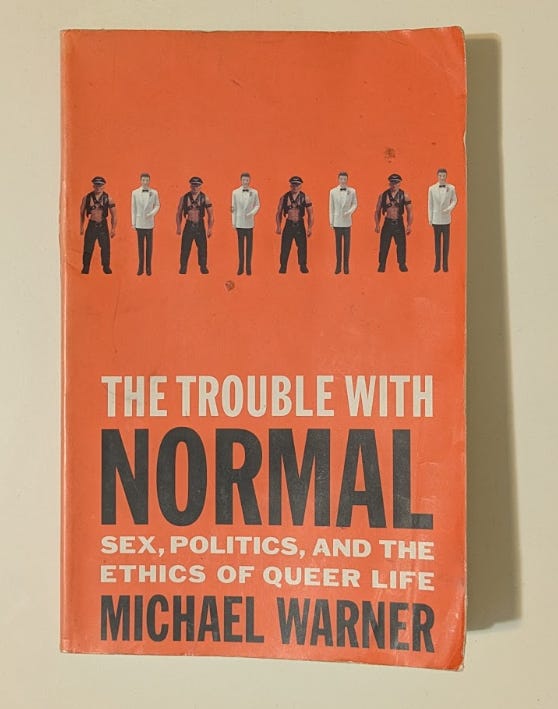
“The Trouble with Normal” (1999)
In his 1999 collection of essays on gay/queer men, Warner argues that sexuality is learned. “[M]ost gay men and lesbians know that the sex they have was not innate nor entirely of their own making, but learned – learned by participating, in scenes of talk as well as of fucking.” He doesn’t say that sexual orientation toward one sex is learned but he leaves the impression it is – or at least, that it’s uncool to believe the science and logic that says it’s innate.
Since sexuality is learned, Warner argues, people “need an accessible culture of sex to tell them anything they deserve to know.” Where conservatives argue that sexuality must be hidden to prevent contagion, Warner argues it must be flaunted to promote contagion:
“[N]ew sexualities, including learned ones, might have as much validity as ancient ones, if not more.”
To evaluate the argument, watch interviews with young men who jumped on the train to castration after becoming addicted to sissy porn (Forrest, Shane). Consider the guy who blocked a busy NYC sidewalk so that people would step on him because he had a trampling fetish – is it good if the tramplers catch his fetish and also begin blocking sidewalks? Question the likelihood that girls will learn a new side of themselves, sexually, by encountering a man dressed like a girl for erotic reasons in their bathroom.
The heart of Warner’s argument for “public sex” is his anguish at watching Mayor Rudy Giuliani clean up New York City.
Warner feels entitled to cruise (pick up strangers in public and have sex with them on the spot) at the Hudson River piers near the West Village and other public lands. Not only that, he believes he deserves privacy in public. “In spaces such as … cruising grounds in secluded park areas, the assumption of privacy is reasonably grounded and should be respected.” Warner is outraged by cops arresting men in the Ramble in Central Park for “nude sunbathing” because that is a “traditionally gay area.”
Guiliani’s cleanup tactics may have been heavy-handed. But for me, a woman who enjoyed their fruit after moving to the city in 2005, Warner’s pro-sleaze arguments hold no appeal. I used to pace the West Village waterfront after a long evening of thinking about studying in the NYU law library. For months on end, walking out on a pier was the only way I turned my back on Manhattan. I’ve always wandered Central Park heedlessly, not worrying whether the section I’m in is reserved for naked men. When I suggest places to meet friends with children, no one has ever responded, “is that near the … traditionally gay area?”
Lesbians would never plant a flag on a universally beloved landmark – we won’t even keep men out of our private roller derby leagues.
Warner has two carrots for lesbians to join his public sex crusade. First, he appeals to our love of strip clubs. “[T]he strip club Angels used to have a lesbian night. It was the only lesbian strip club in New York and a place where even the ‘straight’ nights featured lesbian or bisexual dancers as well as trannies.” Wait – men sponsored an event where women danced nearly-naked together and simulated lesbian sex? And their male customers put up with that? Now that’s LGBTQ+ inclusion.
Second, Warner appeals to our love of porn. He interviews the co-owner of Toys in Babeland on the Lower East Side, which is known as a lesbian sex toy store. The proprietor wants to sell an XXX video but she’s scared Giuliani will punish her.
I actually have some experience with Toys in Babeland. In summer 2006, when I was 21, some friends and I swung by after happy hour. A display caught my eye: a platter with scalloped edges holding four bendy dongs, each in a different shade of beige/brown, with grooves and moldings and lumpy scrotums weighting down the ends.
“WHY WOULD ANYONE BUY A STRAP ON THAT LOOKS LIKE A PENIS?,” I asked my friends. The guys shrugged.
A woman with an unfashionably neat haircut hurried toward me, hands clasped together like a docent at the Holocaust Museum.
“I’m going to ask you to please be respectful,” she said. “Some of our customers use these items for gender play.”
I bolted out the door and never looked back. I had not yet realized that “gender play” was a threat to civilization but I knew one thing: anywhere that reprimands a drunk chick for making fun of penises is not an authentic lesbian establishment.
Warner doesn’t engage feminist arguments against porn directly but there’s a hint he’s heard their concerns: “Am I committed to defending what is sold in Times Square, including the worst of heterosexual culture?” It’s a rhetorical question. The answer appears to be yes.
Warner comes off as a very spoiled man. But he’s exactly what the queer doyennes ordered.
Eve Sedgwick: Yoohoo, boys! We are just dying to know, what are your most perverted desires? Tell us what you want!
Michael Warner: We want to have sex in your kitchen. SCRAM!
Trouble is best known for its argument against gay marriage – the title echoes Sullivan’s and Warner argues with him explicitly. His angst is all over the place. On one hand, he fears marriage because it entrenches state power:
“As long as people marry, the state will continue to regulate the sexual lives of those who do not marry. … It will stipulate at what age and in what kind of space we can have sex.”
On the other hand, Warner demands that the state involve itself with unmarried couples as well as married ones. He creatively calls for:
“expanded domestic partnership, concubinage [a titillating word that can mean domestic partnership], or something like PACS [French domestic partnership] for property-sharing households, all available both to straight and gay people alike.”
Warner complains that the gay organizations fighting for marriage “are simply silent on the consequences of marriage for the unmarried.” What are those, aside from the continued tyranny of age-of-consent laws? Warner fears the unmarried will feel a “shaming distinction.”
But at other points Warner sentimentalizes shame. He thinks shame brings gay men together:
“In the common gossip of friends catching up on girlfriends, in the magazines and videos that are sold and traded around and pored over, in the bars where hair of all kinds gets let down, in personal ads that declare tastes hitherto unknown to man, in scenes where some mad drag queen is likely to find the one thing most embarrassing to everyone and scream it at the top her lungs in Radical Faeries gatherings and S/M workshops–in these and other scenes of queer culture it may seem that life has been freed from any attempt at respectability or dignity. Everyone’s a bottom, everyone’s a slut, anyone who denies it is sure to meet justice at the hands of a bitter, shady queen, and if it’s possible to be more exposed and abject then it’s sure to be only a matter of time before someone gets there, probably on stage and with style. The fine gradations of nerviness that run through this culture measure out people’s willingness to test the limits of shame.”
Warner disdains gay “identitarianism” and exalts “queer politics” over it – but he’s obviously attached to the idea of gay male community. I don’t think he wants to trade the stuffy normal gay guys for ideologically-aligned fag hags and spicy straights. He refuses to say some gay men aren’t queer, even though that would vastly clarify his arguments, because that way he can keep the whole gang together under a more fashionable label. It’s a label that he controls because he is a professor of queer theory.
Standards of Care v. 5 (1998)
While gay men fought among themselves, straight men in dresses banged down their doctors’ doors. They demanded an end to the expectation that they “pass” as the opposite sex and seek genital surgery in order to be prescribed estrogen.
In 1990, a man named Dallas Denny formed AEGIS1 in Atlanta to advocate for “transgendered persons.” Denny reportedly held a psychologist license; it’s unclear if he practiced.
AEGIS included men who “are aroused by cross-dressing[.]” They and other transgendered people, it argued, had a “right to treatment” and a “right to choose their gender.” The treatment should be available a la carte – “it is possible to live a fulfilling role in the gender of choice without ever having reassignment surgery.” In 1994, AEGIS boasted having “broken new ground” by calling “for transgendered persons to consider themselves to be consumers of services[.]”
AEGIS appointed an advisory board of dozens that included medical professionals. It repeatedly surveyed them and transgendered people broadly, establishing itself as a mouthpiece for the community. AEGIS aimed its advocacy at the medical society HBIGDA,2 which it both honored and attacked on a regular basis. When HBIGDA said something out of line, AEGIS shook its head in dismay and called for better “education of caregivers.”
AEGIS’s medical philosophy of “give fetishistic men whatever they want” tracked the legal advocacy pursued at annual ICTLEP3 conferences in Houston, which were first organized by Phyllis Frye in 1991. Neither organization meaningfully defined “gender.”
Trans-identified people began attending HBIGDA conferences at least as early as 1993, according to Denny. (FTM activist Lou Sullivan held onto a registration form from 1989.) In Vancouver in 1997, they protested high ticket prices so HBIGDA let them attend for free. Denny was already slotted to speak. He argued for expanding HBIGDA’s remit to “heterosexual crossdressers” who wanted to grow breasts but keep their genitals intact. His report on the doctors’ reaction: “HBIGDA’s world had just turned upside down.”
The next year, HBIGDA released new medical guidelines, SOC5. It credited Denny as a consultant alongside other trans-identified people: Anne Lawrence, a male MD, and Jamison Green, a female diversity guru. No longer did HBIGDA maintain that the goal of gender medicine was to help patients pass as the opposite sex.4 Now the purpose was purely subjective – “lasting personal comfort with the gendered self.” In other words, the patient alone defined success and failure, sickness and health.
“Undiagnosing Gender” (2004)
The rapid normalization of gayness in the early 2000s posed a crisis for queer theorists. Since the beginning they’d milked state laws against homosexuality to discredit mainstream morality. But in 2003, the US Supreme Court jettisoned them in Lawrence v. Texas. Sedgwick had noted in 1991 that the “contemporary force of the prohibitions against every same-sex sexual expression” gave meaning to queer theory as nothing else did – but now all that was gone. Months later, the jubilant reaction to Massachusetts’ ruling for gay marriage exposed just how popular Sullivan’s agenda was among gay people.
Sure, the queers still had pedophilia. But that served a different role in their ideology. It was what the student encountered after being groomed by tales of gay oppression. What could take homosexuality’s place in that two-step?
In 2004, Butler published “Undiagnosing Gender,” her first exegesis of transgender identity.
The essay questions whether the desire to mimic the opposite sex should be understood non-pathologically or as “Gender Identity Disorder.” Butler rehashes the decades-old discourse in a philosophical register:
“Although one might want to say that [transition] is a choice, even a choice of a dramatic and profound kind, for the purpose of the insurance allocation it has to be a medically conditioned choice. We can surely think for quite some time about what a medically conditioned choice actually is …”
Butler asks questions. For simplicity I’ve inserted the answers implied by the piece:
“Does [the diagnosis of GID] help some people to live, to achieve a life that feels worth living? [Yes.] Does it hinder some people from living, make them feel stigmatized, and, in some cases, contribute to a suicidal conclusion? [Yes.]”
Butler’s analysis doesn’t consider the value of gatekeeping – she tacitly assumes it’s nil, and the only problem is how to maximize the patient’s “autonomy.” She doesn’t touch the questions of what transgenderism actually is or how sex trait change helps the patient.
It’s as though she got all her ideas from Dallas Denny.
Queer Marriage
Before “Undiagnosing Gender,” academic queer theorists only mentioned trans issues in passing, often using day-old terminology and rankling trans sensibilities. Judith Halberstam’s ambivalent chapter on FTMs in Female Masculinity (1998) is a prime example. But Butler’s essay marked the beginning of a new, trans-compliant era for queer theory.
So I peg the merger of trans and queer to 2004. To the extent they resembled each other before then, it’s because they’re both parasites on gay people that deal in sophistry and sex pseudoscience.
At first, there must have been a honeymoon period. Soon gender doctors would announce the importance of respecting children’s autonomy – music to queers’ ears. As foundations, nonprofit law firms, and hospitals started funding jobs in trans advocacy, queer theory professors could help students find careers. And unlike sexual orientation, gender identity is actually a construct – there was no science to wrestle readers away from.
But over the next several years, queer theory didn’t exactly thrive.
“Gaga Feminism: Sex, Gender, and the End of Normal” (2012)
Jack Halberstam, a lesbian whose name used to be Judith, is a professor unafraid to embrace pop culture like Lady Gaga songs. In 2012, she coined a phrase:
“Gaga feminism … is a form of political expression that masquerades as naive nonsense but that actually participates in big and meaningful forms of critique. It finds inspiration in the silly and the marginal, the childish and the outlandish.”
A major theme of the book is “children’s sexuality.” Gaga is a sound that young children make, Halberstam points out. She suggests redefining child abuse from an objective offense to a subjective one:
“[W]hen we really don’t know or understand what children want or how they may feel about [sexual contact with adults], we could always do something wacky and crazy … like asking them to let us know what feels good and what feels intrusive or wrong.”
Halberstam puts a finer point on Warner’s public sex argument:
“[T]he child has all too often served as a justification for the most wretched forms of social and political conservatism ... A lesbian couple I know who live in San Francisco, just to give one example, became alarmed, after the birth of their daughter, about the amount of sexually explicit material in the shop windows in their very gay neighborhood, the Castro. ... This is a couple that for years had engaged in a polyamorous relationship and had incorporated all kinds of sex toys into their sex life. Suddenly, however, on behalf of their infant daughter, they rushed to avoid the very materials that had nurtured their own very queer desires. … [T]he exact sex-negative attitudes that fueled antigay sentiment three decades ago now sneak new forms of sex negativity back into dynamic social systems—but this time via gays and lesbians themselves!”
The irony of gays perpetuating anti-gayness is so uncanny that Halberstam might want to reflect on whether she engineered it. Jack/Judith, are you sure that “sex negativity” is a coherent idea, and not just an empty phrase that pedophiles concocted to link anti-gay animus with shielding babies from erect penises?
Halberstam figures out how to argue that sexual orientation isn’t based in biology:
“Because we receive all kinds of social and interpersonal imprinting at a very young age, often before we can even speak, by the time we reach puberty, our desires, our drives, our particular turn-ons and turn-offs have been established in our psyches in ways that are hard to change and may, in many cases, simply be permanent.”
Halberstam doesn’t cite anything for that theory, though she does broadly allude to Freud a few times in the paragraph.
Halberstam has short hair and wears manly shirts so, she explains, “my gender regularly confuses strangers.” When her partner’s young children ask her if she is a girl or boy, she evades the question.
I couldn’t read this tome cover to cover. Between its bubblegum premise, chipper promotion of “children’s sexuality,” and persistent triteness, I felt embarrassed, like I was staring through a 2-way mirror at a woman snoozing in the nude. This is what queer theory has become?
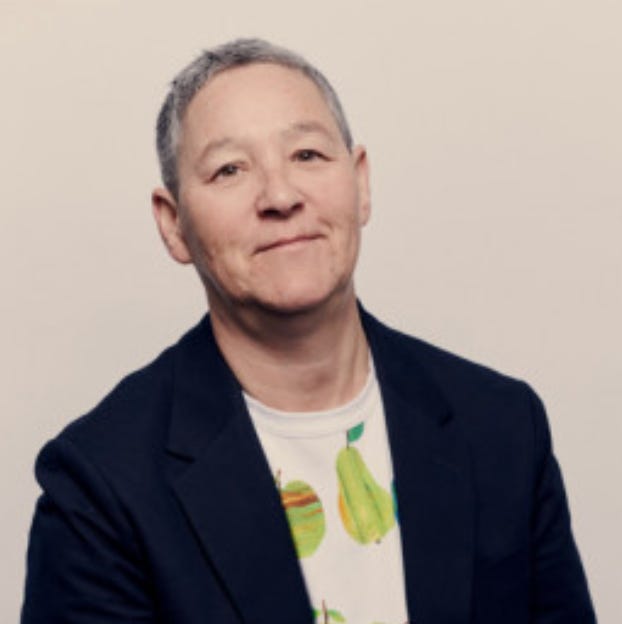
Yes. Halberstam is the Director of the Institute for Research on Women, Gender and Sexuality and the David Feinson Professor of Humanities at Columbia University.
Queer Theory Loses the Plot
From 1984 to 2004, the queer theorists stuck to a precise, sui generis agenda: leverage injustice toward gay people to argue for dismantling all norms related to sexuality. After 2004 – that is, after injustice toward gay people started rapidly melting away – queer theory just sloshed around various progressive discourses adding a glaze of post-structuralism. Maybe we shouldn’t deport terrorists? Maybe working hard is bad? And of course, maybe we should give children whatever pharmaceutical they demand in the name of appeasing their inner gender.
Since many trans ideologues, gay people, and straight people are proudly queer, you might get the sense that queer theory has taken over the world. But keep in mind, first, a lot of everyday queers don’t know what they’re talking about. They haven’t read Rubin or Warner, they vociferously support gay marriage, and they like the child sex abuse laws just as they are. Second, the queers who do understand the mission have compromised it to accommodate trans ideology.
Queer theory’s raison d’etre is to champion transgressive, gross sexuality, so queers should have published dozens of books by now about men who ejaculate after a stranger calls them Ma’am. But they’re silent on this magnificent phenomenon. They seem to be compromising their own pro-kink values out of deference to trans ideologues, who demand that everyone turn a blind eye to transvestic fetishism (even though it’s in the DSM-5).
Andrea Long Chu, an MTF literary critic and masters-level queer, is the closest to an exception. While he has conceded that sissy porn made him think of himself as female and he hinted that his desire to grow chest fat was sexual, he has not written about the feeling it gives him when women pretend he is female. And recently he tried to backpedal from that sissy porn confession (“we must give up the dream of explaining ourselves”).
Queer provokes; trans sneaks. This is a cardinal distinction between the camps. But lately, queers have been sneaking.
Queer theorists also disagree with trans ideologues about “gender identity.” They see the term’s logical infirmity and pseudoscientific nature as clearly as anyone. Chu rejects it, as do other professional queers like the journalist Masha “M” Gessen. They think people should be able to change their bodies however they want and pretend to be whatever sex they want, including “nonbinary” (their favorite sex), without claiming to have a gender identity. But on this point, too, the queers yield.
The ACLU’s Chase Strangio embodies the tension between queer and trans. In interviews and personal writing she has disparaged gender identity and said she’s not a man (“I wasn’t a super binary person. I wasn’t like, ‘I am a man, and I am finally realizing that.’”). With her invocation of “violence” to describe basic social norms and democratically-enacted laws, she’s clearly a disciple of Judith Butler. She bragged about using trans ideology, with its palatable preference for binary discourse, to advance the queer goal of “destabilizing” America’s understanding of sex.
Strangio said that in a moment of oral-history bravada several years ago. By contrast, in court and a recent New York Times interview she toes the trans party line on gender identity (“I think research suggests that there may be some fetal hormonal exposures that make it a biological phenomenon”), lists man and woman as the only examples of gender identity, and refers to “my sense of myself as male.”
While Strangio got to file one lawsuit featuring nonbinary plaintiffs – Orr v. Trump, about passports – her recent buttoned-up rebrand in the NYT suggests the ACLU has ordered her (or she’s personally decided) to forsake queer theory. She’s not really using trans ideology; trans ideology is using her.
The queers capitulated to trans norms of sneakiness and essentialism, abandoning their own values of provocation and constructivism. So they’re done. They were a potent force from 1984 to 2004 but Andrew Sullivan’s generation of gays killed them with normalcy. Ever since then we’ve just been dealing with queer theory in its belching zombie form as it staggers from one socialist die-in to another.
Fear of a Queer Doctor
Despite its flaccidity, queer theory has become a bogeyman for some gender-critical activists. They think queer powers trans because of similarities between the two. But a clever philosophy major can point out similarities between any two schools of thought, especially if they’re allowed to abstract them to almost meaningless generalities.
Whose ideas actually propelled transgenderism? The line runs from Harry Benjamin through the ICTLEP/AEGIS boys, who joined forces with steroidal lesbians to storm HBIGDA, the foundation world and gay nonprofits (rebranding them “LGBT”), then Boston Children’s hospital, the mainstream media, and the Democratic party, which injected it into the veins of American law and K-12 classrooms. Neither the academicky queers nor the daft feminists could get a word in edgewise (though trans ideologues pretend to draw inspiration from feminists for optics).
Queer theory’s legacy isn’t spreading evil but rather obstructing reason. These philosogres diverted bookish gay and female millennials from actually helping gays and women. Sure, in some cases they goaded students into taking up discursive arms on behalf of a cause. But the cause wasn’t queer. It was trans.
Related
How trans ideology penetrated American medicine in 1966
Timeline of Trans Domination, 1993-2007 (revised Dec. 2025)
Putting trans ideology and queer theory into the context of real-world events
American Educational Gender Information Service
Harry Benjamin International Gender Dysphoria Association
International Conference on Transgender Law & Employment Policy
SOC4 (1990): “Hormonal sex reassignment … [is for] the purpose of effecting somatic changes in order for the patient to more closely approximate the physical appearance of the genotypically-other sex. … Genital surgical sex reassignment refers to surgery of the genitalia and/or breasts performed for the purpose of altering the morphology in order to approximate the physical appearance of the genetically-other sex in persons diagnosed as gender dysphoric. …”