
Queers Rush In (Part 2)
Meet the straight English professor who taught gay biology

“I wanted to take a department that was set in its ways and insecure about itself and make it a national center of attention.”
–Stanley Fish (2024)
“Please don’t use that term ‘straight.’”
–Eve Kosofsky Sedgwick (1998)
In 2018, New York University suspended its premier Comparative Literature professor, Avital Ronell, after finding she had sexually harassed her grad student – a gay man more than 30 years her junior. Ronell’s old friend, the UC Berkeley philosopher Judith Butler, wrote a letter to NYU’s president. She (and the dozens of academics she recruited to sign on) accused the grad student of “malicious intention” and demanded “that [Ronell] be accorded the dignity rightly deserved by someone of her international standing and reputation.”
The story made waves not only because of the squicky allegations (the student said Ronell kissed him, required him to share a bed with her and touch her breasts, and called him “Sweet cuddly Baby”), but because of all the hypocrisy on display. Ronell, Butler, and many of the letter’s signatories were known as feminists. And Ronell, according to the New York Times, was a lesbian. Headline: What Happens to #MeToo When a Feminist Is the Accused?
Why were experts on equality flunking the quiz that HR gives at the end of sexual harassment training? Why did a lesbian risk her career to snuggle with a man? What the hell was going on?
This is Part 2 of a trilogy on queer theory. In Part 1 I described how Butler and Gayle Rubin, disillusioned with their fellow lesbians, laid the intellectual groundwork. Now I’ll explain why their niche project thrived in 1990s academia – and became known as feminist. Next time, in Part 3, I’ll show how the queers adopted trans ideology after 2000 and wreaked havoc beyond the campus gates.
And now, the straight guy who invested in Gay & Lesbian Studies.
Stanley Fish, b. 1938
Professor of English Stanley Fish said he was a conservative. Right wingers didn’t believe him because he called their views “racist, sexist, and homophobic.” What was Fish’s true identity? Consider the evidence.
Fish scoffed at “classical liberal” ideals – the kind shared by principled Americans on both sides of the aisle – like free speech, objectivity, and fairness. “[T]he liberal strategy is to devise (or attempt to devise) procedural mechanisms that are neutral with respect to point of view and therefore can serve to frame partisan debates in a nonpartisan manner.” He thought this was a vain project. “[I]t is too little to say that liberalism doesn’t work; one should say … liberalism, bereft of its formal center, doesn’t exist.”
As a young, Yale-trained Milton scholar in the 1970s, Fish became known for puckish literary criticism – he argued the meaning of a novel lay with the reader, not in the text itself. In 1985 he took a job at Duke University, in Durham, NC, as dean of its respectable but stodgy English Department. Having embraced “black studies, ethnic studies, gay and lesbian studies, and so on,” he sought to revamp Duke by recruiting some of those fields’ edgiest voices. They included Henry Louis Gates, Jr., who’d later become famous for a showdown with a Cambridge cop who asked to see his ID, and Eve Kosofsky Sedgwick, an expert in identifying gay innuendo in old books. Duke cheerfully bankrolled the renovation.
Fish’s gambit worked. Between 1986 and 1991, applications to its graduate program quadrupled, almost 50% more Duke undergraduates majored in English, and the department leapt up in various national rankings. “If ever an academic department was hot,” the NYT would later reminisce, “it was the English department at Duke University in the late 1980’s and early 1990’s[.]”
Just because Fish threw money at Marxists doesn’t mean he plotted to indoctrinate Southern belles into communism. He drove a Jaguar. In 1991 he published an essay called “The Unbearable Ugliness of Volvos” that mocked his colleagues for buying practical cars in an effort “to enjoy the benefits of increasing affluence while at the same time maintaining the proper attitude of disdain toward the goods affluence brings.” Fish’s friend David Lodge, the novelist, based a character on him whose goal in life was to become the highest-paid English professor in the world.
Fish aimed to make Duke “a national center of attention.” He succeeded because conservative intellectuals – who’d been glowering at the academy since the Vietnam era – started calling Duke “the Fish Tank.” (It didn’t hurt that Duke became a basketball powerhouse during this period.) They published at least five books attacking the “critical theory” he championed, three of which excoriated him personally:
Closing of the American Mind by Allan Bloom (1987)
Profscam by Charles Sykes (1989)
Tenured Radicals by Roger Kimball (1990)
Illiberal Education by Dinesh D’Souza (1991)
Impostors in the Temple by Martin Anderson (1992)
For all the youthful excitement around “_____ studies,” the economy of humanities scholarship was teetering. In early 1991, the NYT covered the recent Modern Language Association (MLA) conference:
“Tweed still abounds, but in Chicago it is sometimes transformed into downtown punk via glittery leggings, ripped Levi’s and the Silence = Death buttons of AIDS activists. … [T]he study of literature has in two generations changed more than any other academic field, including the sciences.”
Universities interviewed early-career scholars for jobs at MLA. But not that many jobs. NYT reports on the desperate competition over “precious few college-teaching slots:”
“If the MLAs of the last decade centered on literary theory, in the 1990’s scholars in the humanities are more likely to focus on turf battles and budget crises. Many universities have begun to trim liberal-arts departments in order to support science research or to expand schools of medicine and business. ... Deans who in the mid-1980’s bid lavishly for superstar theorists now want cost-efficient teaching, and lots of it.”
Duke’s English department wilted under the light of those stars. By 1998, the university had placed its 40 members under the care of a botanist. “[S]ome of those working within literature are using literature as an instrument to try to affect social change,” the English professor James Applewhite charged. Sedgwick countered there was “a whole group of faculty who really felt that the department was too theoretical, too queer, too African-American.”
Despite the drama, Duke PhDs were still finding placements. From the MLA dispatch, it seems the rest of America’s universities had ordered themselves in the Fish Tank’s image. According to Fish himself, who was headed to a higher-paying gig at UI–Chicago, “the lack of clear mission is a feature, I believe, now of the profession and not just this department.”
So, was Fish a conservative? Sure. He loved capitalism, opposed social justice activism in the classroom, and did everything within his power as an English professor to sabotage the left’s reputation. As for the identity antics – it was his business.
Eve Kosofsky Sedgwick, 1950-2009
In 2023, a gay man named Blake Smith wrote of Eve Kosofsky Sedgwick in Tablet:
“I am troubled whenever I read Sedgwick—a fat straight woman … —write about male anal eroticism with annoyingly evident delight at her transgression of academic propriety.”
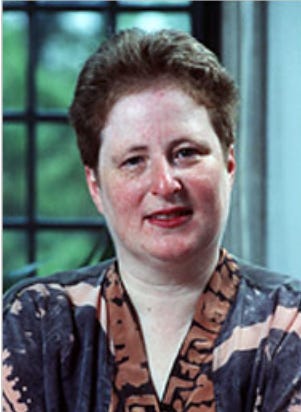
Sedgwick, who died of breast cancer in 2009, loved Victorian novels and gay men. As to her own sex life, it was “vanilla” and took place with “one person of the so-called opposite sex,” her college sweetheart. But her “erotic and intellectual life” was so much more than that. She explained in “White Glasses” (1991) that she was “someone who had it at heart to make decisive interventions on … the scene of gay men’s bonding, community, thought, and politics[.]” In fact, she held an “identity … as a gay man.”
How does a woman intervene on gay men when she’s armed with nothing but literary theory? Sedgwick constructed a new paradigm of “gay” criticism by scavenging for homoerotic subtext between male characters in classic literature and arguing the subtext was similar across many works. This positioned her as an expert on gayness.
A 1999 Salon profile praised Sedgwick’s boundary-crossing. “Far from the narcissism gay scholars are often accused of, her work did not theorize the world to prop up her own identity.1 Rather, she invented a new world in which even she was a stranger.”
I’m only aware of one woman who called herself a gay man before Sedgwick: Lou Sullivan, born a year after her. She medicalized, enjoyed a prolific sex life with the objects of her fetish, had fake testicles sewn to her labia, and died of AIDS in 1991.
Sedgwick argued sexuality is a construct. In 2008 she wrote that the “dividing up of … all persons … under the ‘opposite’ categories of ‘homo’ and ‘hetero’ is not a natural given but a historical process[.]” She based this analysis not on scientific evidence (which suggests people are hard-wired for attraction based on sex) but on her own speculative insights into the hidden desires of fictional characters.
“How to Bring Your Kids up Gay” (1989)
In the late 1980s, three remarkable studies of gay men and boys were published.
The “Sissy Boy Syndrome” and the Development of Homosexuality (1987), by the psychiatrist Richard Green, connected early femininity in boys with later gay orientation. Green would eventually lead the charge to legalize puberty blockers in the UK for this cohort.
Male Homosexuality: A Contemporary Psychoanalytic Perspective (1988), by the psychiatrist Richard C. Friedman, recounted the lives of gay men.
Finally, in 1989 the US Department of Health and Human Services released a report on youth suicide. It found that “gay youth face a hostile and condemning environment, verbal and physical abuse, and rejection and isolation from families and peers,” leading to higher rates of suicide attempts and completions. The report was professional and neutral, but its publication was marred when HHS’s own secretary condemned the gay chapter as departing from “traditional family values.”
Sedgwick analyzed these three texts in a 1989 essay, “How to Bring Your Kids up Gay.” It’s styled as an appeal to save feminine boys from conservatives, psychiatrists – and gay politics.
As to the psychiatrists: “Revisionist analysts seem prepared to like some gay men, but the healthy homosexual is one who (a) is already grown up, and (b) acts masculine.”
As to gay politics, Sedgwick argues gay acceptance is based on divorcing gender nonconformity from sexual attraction, i.e., pointing out that gay men can be masculine:
“That one woman, as a woman, might desire another; that one man, as a man, might desire another: the indispensable need to make these powerful, subversive assertions has seemed, perhaps, to require a relative deemphasis of the links between gay adults and gender-nonconforming children.”
She suggests this hurts boys:
“There is a danger … that that advance may leave the effeminate boy once more in the position of the haunting abject—this time the haunting abject of gay thought itself.”
Sedgwick likes that literary theorists are “distinguishing gender from sexuality.” But she fears psychiatrists are exploiting that “theoretical move” for evil ends – to create “the new pathologization of an atypical gender identification.” She continues:
“The renaturalization and enforcement of gender assignment is not the worst news about the new psychiatry of gay acceptance ... The worst is that it not only fails to offer, but seems conceptually incapable of offering, even the slightest resistance to the wish endemic in the culture surrounding and supporting it: the wish that gay people not exist.”
“Gender assignment” (sex) is in fact natural (real) so I wouldn’t be too worried about its “renaturalization.” As to whether reality helps us “resist” anti-gay attitudes, yes. You only need to argue binary sex is natural, deviation from sex-based personality norms is natural, homosexuality is natural, and nature is good.
But Sedgwick urges suspicion of nature arguments:
“What whets these fantasies [of eradicating homosexuality] … is the presentation, often in ostensibly or authentically gay-affirmative contexts, of biologically based ‘explanations’ for deviant behavior that are absolutely invariably couched in terms of ‘excess,’ ‘deficiency,’ or ‘imbalance’—whether in the hormones, in the genetic material, or, as is currently fashionable, in the fetal endocrine environment.”
What if the biologically based explanation is accurate? Sedgwick would reject the premise that a statement can be “accurate.” Verifying and falsifying claims isn’t in her _______ studies toolkit. Like Butler and Rubin, she’s a constructivist. What matters is how we talk about things that other people consider true, i.e., how we can create reality by manipulating the public discourse.
Sedgwick thinks “there is no unthreatened, unthreatening theoretical home for a concept of gay and lesbian [biological] origins” – at least until society has “a strong, explicit, erotically invested affirmation of some people’s felt desire or need that there be gay people in the immediate world.” Sedgwick herself has a felt desire for gay people (men), so she’s demanding that society affirm her. Until then, her battle plan goes, we should pretend there’s no biological basis for homosexuality in order to thwart secret plans to eradicate gay people.
In sum, Sedgwick’s PR strategy for homosexuality de-centers actual gay people in favor of straight people who fetishize them, and holds scientific information hostage until she is assured of ongoing affirmation.
At one point she reveals her personal stake. In the text she laments “effeminophobia” in the “gay movement.” But in a footnote to that point she expresses optimism (emphasis added):
“[R]elegation [of effeminate men] may be diminishing as, in many places, ‘queer’ politics come to overlap and/or compete with ‘gay’ politics. Part of what I understand to be the exciting charge of the very word ‘queer’ is that it embraces, instead of repudiating, what have for many of us been formative childhood experiences of difference and stigmatization.”
Sedgwick likes the idea of replacing the biology-based gay movement that excludes her with a bullshit-based queer movement that includes her. She’s pushing a personal agenda under the pretext of saving feminine boys.
White Glasses (1991)
At the 1986 MLA conference, Sedgwick met a gay poet-theorist named Michael Lynch who had just that day learned his ex had AIDS. His white glasses stuck in Sedgwick’s mind. She fell in love with him and they became close friends. In 1991, as he lay dying of AIDS, she delivered a speech to a conference at the CUNY Center for Lesbian and Gay Studies about her “instant, fetishistic crystallization of him through those white glasses[.]”
Sedgwick scoured multiple cities for facsimiles, which she now wears:
“So often I feel that I see with Michael’s eyes ... It is as if we were both the man in the iron mask; different men in the same iron mask.”
This is the piece where Sedgwick comes out “with all a fat woman’s defiance … as a gay man.” She describes, in convoluted third-person terms, who she was at the 1986 conference:
“It was nobody simpler than the handsome and complicated poet and scholar I met in him; it was a queer but long-married young woman [age 35-36] whose erotic and intellectual life were fiercely transitive, shaped by a thirst for knowledges and identifications that might cross the barriers ...”
Sedgwick attends an event “for lesbians” and rebukes the performer for arguing research funds are going to AIDS instead of breast cancer – “as though AIDS were not a disease of women, of lesbians!” (AIDS is not a disease of lesbians.)
Sedgwick acknowledges the “obsessive imagery” she indulges in regarding Michael:
“When I am in bed with Michael, our white glasses line up neatly on the night table and I always fantasy [sic] that I may walk away wearing the wrong ones.”
Maybe Michael enjoyed this attention. I have no basis for believing otherwise. But it was this essay, not the NYT story on Avital Ronell’s Title IX debacle, that triggered in me a decades-old memory: a straight woman had long openly crushed on a gay friend of mine. After a breakup she began clinging to him. One night she came to his apartment and pressured him into spooning her all night. As he relayed it to me, I perceived he felt deeply embarrassed and grossed out by the protracted canoodle (not only was he biologically gay, he was biologically standoffish). He begged me not to tell any of our friends.
Impact Lit Crit
Sedgwick disclaimed activism – mostly. NYT in 1998:
“Ms. Sedgwick said she never thought of queer theory as a basis for political action. But in recent months, her writings have been the inspiration for the increasingly vocal group Sex Panic, which is fighting what it sees as an oppressive attempt to restrict gay sexual behavior: efforts to close bathhouses and movie theaters for instance, in the belief that they are sites of sexual behavior that has a high risk of spreading AIDS. ‘I feel very privileged,’ Ms. Sedgwick said, ‘that queer theory has been useful for political work that seems important for me.’”
At the time, many gay men were fighting for rights that would enhance their potential: marriage equality, adoption, anti-discrimination. Sedgwick associated with none of it, only with an alternative vision of queer libertinism that led straight to HIV infection. To top it off, she oddly described this work as “important for me,” where you’d expect her to say “to me” or better yet, “to gay men.”
Forget politics. Sedgwick didn’t even help out gay men on her own college campus. In 1999, the Princeton Review ranked Duke the worst climate for gay acceptance of 331 top schools, based on student surveys.
In his recent memoir Cis White Gay, Ben Appel relates how he felt encountering queer theory at Columbia:
“Coming to understand myself as a gay person is what made me feel whole. So to be told that my ‘homosexual’ identity was merely a consequence of changing societal norms, rather than something innate and immutable – God-given, if you will – made me feel vulnerable and depressed.”
Sedgwick anticipated that objection. In Bring, she argues:
“[C]onceptualizing an unalterably homosexual body … can reassure profoundly. At the same time, however, in the postmodern era it is becoming increasingly problematical to assume that grounding an identity in biology or ‘essential nature’ is a stable way of insulating it from societal interference.”
The biological explanation of homosexuality doesn’t appeal to gay people because it insulates them from society but rather because it’s true. Sedgwick doesn’t care about gay craving for truth – nevermind truth itself.
How the Gays Became Queer
Professor Teresa de Lauretis is credited with coining “Queer Theory” at a conference on gay and lesbian studies in 1990. She said she wanted to “avoid all of these fine distinctions in our discursive protocols … [and] to both transgress and transcend them – or at the very least problematize them.” But by 1994 she’d recoiled from her baby. In an essay on lesbian sexuality, she wrote that “since I proposed [queer theory] as a working hypothesis for lesbian and gay studies … [it] has very quickly become a conceptually vacuous creature of the publishing industry[.]”
Sure, blame capitalists for mucking up your perfectly clear command to problematize fine distinctions in discursive protocols. Anyway, it was too late. “Gay and lesbian” lingered on the nonprofit scene, perhaps because it appealed to normies, judges, and politicians. But queer quickly swallowed gay within academia.2
The queers had funding now. Their books in the 1990s thank Rockefeller, Carnegie, Kirkland Endowment, and various universities. In 1995, the Ford Foundation started up the Sexual Research Fellowship Program, which aimed to buttress work in the social sciences and humanities that government and traditional foundations wouldn’t touch. Academic presses were psyched to publish critical theory, according to the 1991 MLA article. Duke’s published at least a dozen queer books by 2005. GLQ was founded in 1993 and printed queer articles from day 1. Duke acquired it in 1997. All of this academic infrastructure beckoned students toward careers in queer theory – they believed they could study, publish, and ultimately land gigs in a Fish Tank franchise.
Undergraduates (universities’ customers) sought out queer theory classes. In 2013, a young Guardian reporter explained why she loved Butler and Sedgwick:
“So why did it strike such a chord with this straight girl? Well, Sedgwick herself married a man, Hal Sedgwick, though she would not have used the term ‘straight,’ seeing sexual identity as a continuum rather than a category. And if queer is anything, it’s a retort to the idea that your sexual (or any) identity must define you in a static, limiting way, and above all, that it may be used to vilify you.”
Sedgwick herself marketed queer theory to the hetero masses in 1998:
“It’s about how you can’t understand relations between men and women unless you understand the relationship between people of the same gender, including the possibility of a sexual relationship between them.”
As much as Sedgwick emphasized the interests of straight people, she never let the gays wriggle out of her grip. From “Queer and Now” (1991):
“[G]iven the historical and contemporary force of the prohibitions against every same-sex sexual expression, for anyone to disavow those meanings, or to displace them from [queer’s] definitional center, would be to dematerialize any possibility of queerness itself.”
In English: gay is the only part of queer that is actually real and not a discursive protocol. You can’t sell queer without gay. Sedgwick begins the same essay with statistics about gay youth suicides. Unlike Gayle Rubin, she knows she can’t wring pathos out of pedophiles and leather costumes.
Queer theorists turned up their noses at mainstream gay activism. Butler in 2004:
“the state’s offer [of marriage rights] might result in the intensification of normalization[.]”
But most Americans have never read their tracts and assume they are pioneers of today’s normie gay legal regime. NYT in 2009:
“Sedgwick’s radical challenge to heteronormative ways of reading and living may seem quaint (if that’s the word) in a time when people are celebrating same-sex weddings in Iowa and the White House Easter egg hunt conspicuously includes gay and lesbian families.”
Across three essays in Tendencies (1993), Sedgwick employed the word “rectum” 20 times. Barack Obama’s gay Easter egg hunt did not render her quaint.
How the Queers Became Feminist
The queers are cagey about feminism. They undermine it constantly but also let people believe they identify with it. Butler in 2004:
“To question a term, a term like feminism, is to ask how it plays, what investments it bears, what aims it achieves, what alterations it undergoes. The changeable life of that term does not preclude its use. If a term becomes questionable, does that mean it cannot be used any longer, and that we can only use terms that we already know how to master? [No answer provided.]”
In Sedgwick’s 1992 preface to Between Men, she explains that when she wrote the book years earlier:
“I … wanted – needed – feminist scholarship to be different. In particular, I found oppressive the hygienic way in which a variety of … contingencies promised (threatened?) to line up together so nearly in the development of a feminocentric field of women’s studies in which the subjects, paradigms, and political thrust of research … might all be identified with the female.”
So Sedgwick’s preferred feminism is not feminocentric or identified with the female. OK. What is it? Maybe her feminism is that which contradicts feminism. In “Queer and Now” (1991) she describes feminists fighting on both sides of an ideological battle (emphasis added):
“The term ‘politically correct’ originated … in the mockery by which experimentally and theoretically minded feminists, queers, and leftists (of every color, class, and sexuality) fought back against the stultifications of feminist and left anti-intellectualism. The hectoring, would-be-populist derision that difficult, ambitious, or sexually charged writing today encounters from the right is not always very different from the reception it has already met with from the left.”
If you think the two feminisms share something in common – as might be implied by their being the same word – Sedgwick has an insult for you later in the paragraph:
“The right’s success in grouping so many, so contestative, movements under the rubric ‘politically correct’ is a coup of cynical slovenliness unmatched since the artistic and academic purges of Germany and Russia in the thirties.”
Despite the queers’ ambivalence toward feminism, they had entree into its academic wing. For example, Sedgwick’s Between Men (1985) was published in a “feminist book series.” Given how “fag hag” culture exploded later in the 1990s, I wonder if a lot of women just liked the idea of dancing with gay men – the praxis of early American queer theory.
The inventors of queer theory didn’t claim to advance women’s interests, nor did they focus on women. They did not study women’s distinct experiences; they did not celebrate women’s unique qualities; they did not fight for women-specific causes. They doubted that “woman” was a material reality. In a logical world they’d be called “anti-feminists” or at least “not feminists.” But in the academic world they became known as “third wave feminists.”
The Third Wave
The coinage is credited to Rebecca Walker, daughter of Alice. In 1992, Ms. Magazine published the 22-year old’s essay, “I Am the Third Wave.” It’s a conventional feminist roar against Clarence Thomas, who’d been recently installed on the Supreme Court despite accusations of sexual harassment by Anita Hill. “He was promoted. She was repudiated. Men were assured of the inviolability of their penis/power.”
When Walker drops the phrase “third wave,” she seems to be referring to youthful invigoration:
“I push myself to figure out what it means to be a part of the Third Wave of feminism. … My involvement must reach beyond my own voice in discussion, beyond voting, beyond reading feminist theory. My anger and awareness must translate into tangible action.
“I write this as a plea to all women, especially the women of my generation: Let Thomas’ confirmation serve to remind you, as it did me, that the fight is far from over. Let this dismissal of a woman’s experience move you to anger. Turn that outrage into political power. Do not vote for them unless they work for us. Do not have sex with them …
“I am not a postfeminism feminist. I am the Third Wave.”
This sounds nothing like the pervert-inclusive, kink-forward, apolitical, andro-curious theorizing of the queers. Yet over time, the queers became known as “third-wave feminists.” Why?
They didn’t definitively accept or reject the label. But they did keep associating themselves with feminism without clear explanation. None of them ever wrote an essay called “Why I Am a Feminist Even Though I Reject Feminism” or “How to Be a Feminist in a World Without Women.”
Nature abhors a vacuum. People inferred that the queers belonged to this not-so-defined third wave; and whatever the third wave was, it explained how the queers were feminist.
These middle-aged white women probably didn’t mind the association with Walker, a young black woman – and with Kimberle Crenshaw, a young black legal scholar focused on racial justice who became a marquee third waver. The queers had prepared for this moment for years by tossing uncooked race gibberish into their sex essays. From “White Glasses:”
“On women of all colors white refers … to the ways in which our gender tries … to inscribe in us … the zero-degree no-color of (not the skin of Europeans themselves but) the abstractive ideology of European domination. A white woman wearing white: the ruly ordinariness of this sight makes invisible the corrosive aggression that white also is …”
Pretending the queers were feminist suited many parties – the boomer queers who wanted to keep scoring grants from funders who recognized the word “feminist;” the rising generation of feminocentrists who could benefit from alliances with established professors; the conservative culture warriors whose job got easier; the legions of men, right and left, gay and straight, who didn’t want to look too closely at Eve Kosofsky Sedgwick.
Anti-porn “radical feminists” were the only people knowledgeable and rude enough to say “those crazy bitches aren’t feminists.” But they were in no condition to take down the queen bees of MLA. Few Gen Xers appreciated their mordant warnings about “phallocracy” and dogmatic denials that lesbians ever prey on each other. Plus, they couldn’t attack queers for appropriating gayness because they supported “political lesbianism” (straight women pretending to prefer women over men).
Back to Avital Ronell’s 2018 scandal. Why did a lesbian force a man into her bed? Wrong question. Ronell didn’t call herself a lesbian. In the NYT article, she referred to herself as “queer.” NYT itself used the term “lesbian.” The reporter, Zoe Greenberg, treated the two as synonyms. The year before, she’d written on schools eager to serve “nonbinary” students and Chimamanda Ngozi Adiche’s “ill-informed” statements on trans-identified men. Dissolving homosexuality into queerness is what up-to-date journalists do now.
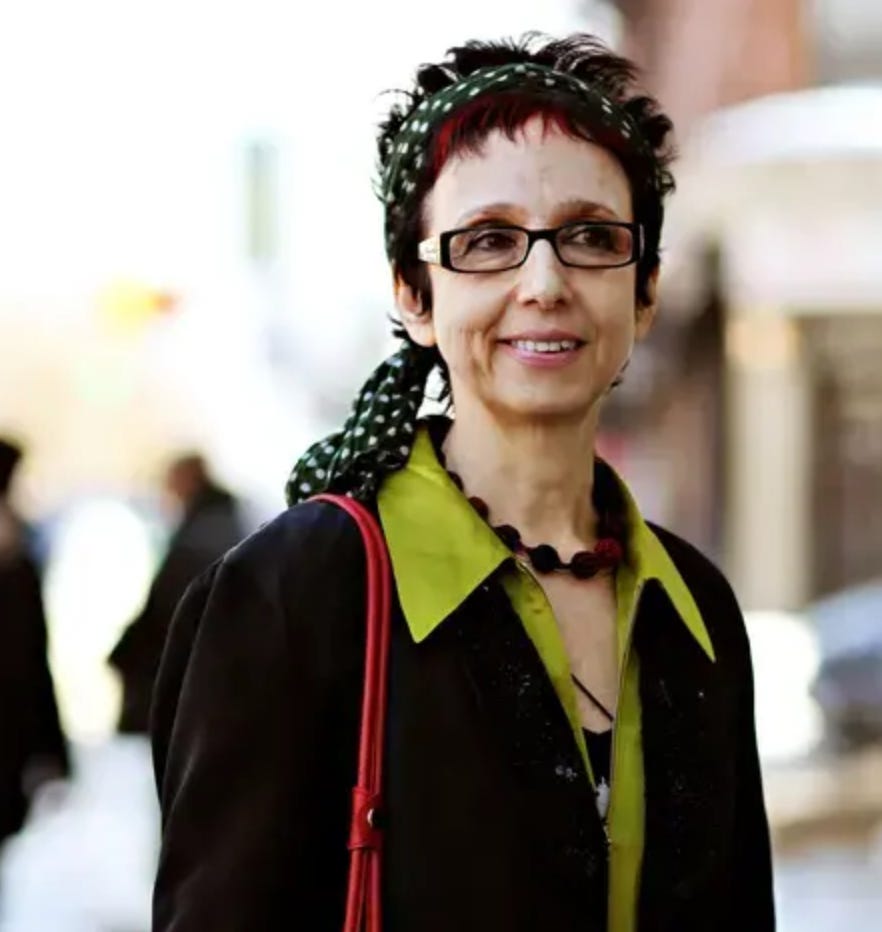
Like a lot of queers, Ronell wears a gay skinsuit: short hair, designer glasses, and button down shirts. But you can tell she’s straight because in photos she’s baring her chest and covering her arms. Lesbian sex pests show off their biceps. Also, at age 27 she hooked up with a 16-year old boy.
Judith Butler discussed sexual harassment in 2004. She said banning it turned it into “the allegory for the production of gender.” Worse, she argued, in what might be a cryptic defense of Bill Clinton:
“[T]he abuse of sexual harassment doctrine by the conservative Right in its persecutorial inquiries into sex in the workplace present a serious public-relations problem for feminists on the Left.”
Forget how sexual harassment laws affect women. What violence do they inflict on the discourse?
Queer feminists did not pass Title IX. They did not research how to expand economic opportunity. They never promised you they wouldn’t sexually harass gay guys. In fact, they gave you every indication that they would sexually harass gay guys. Their MO is to cross boundaries and subvert reality using language, i.e., to deceive, in a manner that is risque and ropes in handsome men whenever possible.
In Part 3 I’ll show why that’s been a boon for gender doctors.
I wonder if this is a dig at Sedgwick’s contemporary, Terry Castle, who prosecutes the case that classic novels are overflowing with “apparitional lesbians.” I actually like Castle. Her writing is lively and doesn’t push a queer or narcissistic agenda. She just has women on the brain.
Considering that Rubin, Butler, and Sedgwick had been trying to shed conventional gay and lesbian categories for years, it’s suspicious that queer theorists pin the move on a figure who genuinely valued lesbian scholarship. I wouldn’t be surprised if there’s more to the history.
Glenna Goldis’s Queers Rush In represents a long-overdue corrective to the dominant narrative about gay and lesbian history, especially in elite academic and activist circles.
For the last 30 years, that history has been refracted through the distorting lens of queer theory, which treats fixed sexual orientation as passé, erases the specificity of same-sex attraction, and valorizes “fluidity” and anti-normativity as political goods in themselves. The result has been a profound flattening of gay and lesbian experience, a rhetorical sleight of hand that collapses hard-won civil rights gains into a diffuse project of “queering” institutions rather than securing equal citizenship.
Goldis restores analytic clarity to the conversation by insisting that male and female homosexuality are not merely social constructs or aesthetic sensibilities, but historically situated, materially grounded identities with their own trajectories, communities, and cultures. This is not nostalgia—it’s recovery work, and it’s essential.
Many readers may find Goldis’s argument startling not because it is polemical, but because it revives a history they’ve never been taught. For most people under 40, “queer” has always been the default identifier—presented as inclusive, liberatory, and intellectually evolved beyond “gay” or “lesbian.” They were educated in an environment where “fluidity,” “constructedness,” and “anti-normativity” weren’t hypotheses but background assumptions. They have no memory of the intellectual and cultural life that preceded queer theory, and no felt sense of what has been overwritten. Even those who intuit that something vital has been flattened or erased often lack the historical knowledge or conceptual tools to name what’s been lost. Social pressure reinforces this: raising doubts about queer orthodoxy, even in good faith, risks being cast as exclusionary or reactionary. Goldis’s piece is valuable precisely because it helps restore access—not just to memory, but to options.
I often wonder how I managed to get through college (1990-1994) without getting lost in the land of postmodernism.